Analyzing Variations in Goal Scoring Betting Markets Between Exchanges and Bookmakers
Clara Berger · Aug 15, 2026
Analyzing Variations in Goal Scoring Betting Markets Between Exchanges and Bookmakers
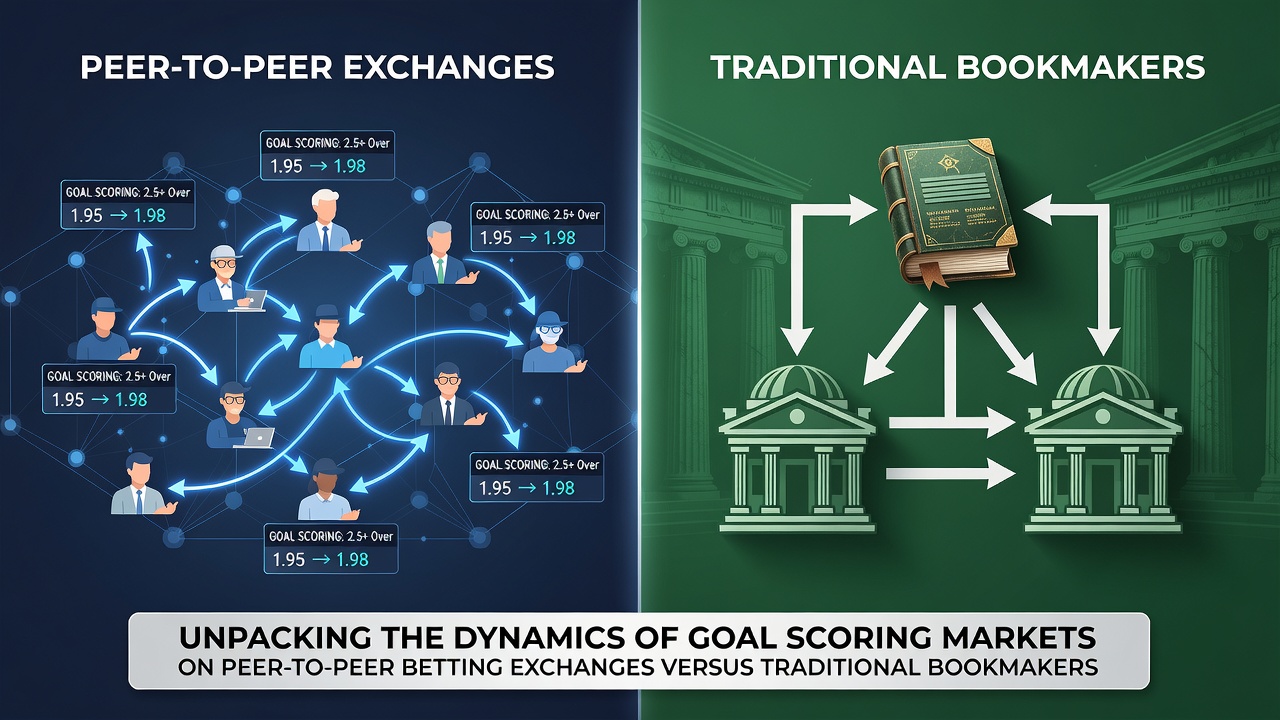
Goal scoring markets represent a significant portion of football betting activity, and observers note distinct operational differences between peer-to-peer exchanges and traditional bookmakers in how these markets function. Data from industry reports indicate that exchanges facilitate direct user-to-user matching on outcomes such as total goals, next goal scorer, and over-under thresholds, whereas bookmakers maintain fixed odds and absorb the risk themselves.
Core Mechanics of Peer-to-Peer Exchanges in Goal Markets
Peer-to-peer platforms operate through a system where participants place opposing bets on the same goal-related proposition, with the exchange taking a commission on matched wagers rather than setting prices. Researchers have documented that liquidity in these markets often builds rapidly during live matches because users can adjust positions in real time as goals occur or as match dynamics shift. Figures from August 2026 showed increased trading volumes on goal lines during major European league fixtures, driven by the ability to lay or back at varying prices throughout the game.
Those who monitor exchange activity point out that price discovery emerges from collective user input, allowing odds on goal scoring to fluctuate based on supply and demand. This structure permits strategies such as trading positions in and out of the market before a goal is scored, something not available when dealing with fixed-odds operators. Studies from academic sources have examined how this back-and-lay flexibility influences participant behavior in high-scoring or low-scoring scenarios.
Traditional Bookmaker Structures for Goal Scoring
Traditional bookmakers compile goal scoring markets by assessing statistical models, team form, and historical data to establish initial odds. Once published, these odds remain static until the bookmaker decides to adjust them, often in response to incoming stakes or external information. Industry analyses reveal that such operators typically offer fewer in-play adjustments on goal totals compared with exchanges, focusing instead on pre-match lines and occasional half-time revisions.
Evidence from regulatory filings across multiple jurisdictions demonstrates that bookmakers manage risk through margin inclusion and stake limits on goal-related bets. When heavy activity concentrates on one side of a market, such as over 2.5 goals, the operator may close the line or shift the price to balance exposure. This approach differs from the continuous price movement seen when users interact directly on exchanges.

Comparative Liquidity and Odds Movement Patterns
Comparative examinations show that exchanges frequently display tighter spreads on goal scoring propositions because competition among users drives prices toward equilibrium. Traditional operators incorporate a built-in margin that remains consistent regardless of market activity, leading to wider gaps between back and lay equivalents. Data compiled by research institutions indicate that during periods of high goal expectancy, such as matches involving attacking teams, exchange prices can move several increments within minutes while bookmaker lines adjust more slowly.
What's interesting is how settlement timing aligns across both models. Both systems resolve goal markets based on official match statistics, yet the path to those outcomes involves different risk allocations. Observers have noted that exchanges shift risk entirely between participants, whereas bookmakers retain responsibility for unmatched or unbalanced positions throughout the event.
Regulatory Context and Market Availability
Reports from bodies such as the Australian Gambling Research Centre highlight that availability of goal scoring markets varies by jurisdiction, with exchanges facing different licensing requirements than fixed-odds providers. In August 2026, several operators expanded their goal-related offerings in response to evolving demand patterns observed across digital platforms. These expansions occurred alongside updates to responsible gambling tools that apply uniformly to both exchange and bookmaker products.
Additional analysis from the Nevada Gaming Control Board underscores how transaction volumes in goal markets correlate with fixture schedules and broadcast coverage. The data illustrate that exchanges tend to attract participants seeking granular control over entry and exit points, while traditional bookmakers serve those preferring straightforward fixed-price options without the need to monitor live price changes.
Conclusion
Goal scoring markets continue to evolve as both peer-to-peer exchanges and traditional bookmakers adapt their offerings to participant preferences and technological capabilities. The structural distinctions in risk management, price formation, and liquidity provision remain central to how these platforms operate side by side. Continued monitoring by industry analysts provides ongoing insight into how these differences manifest across various football competitions and time periods.